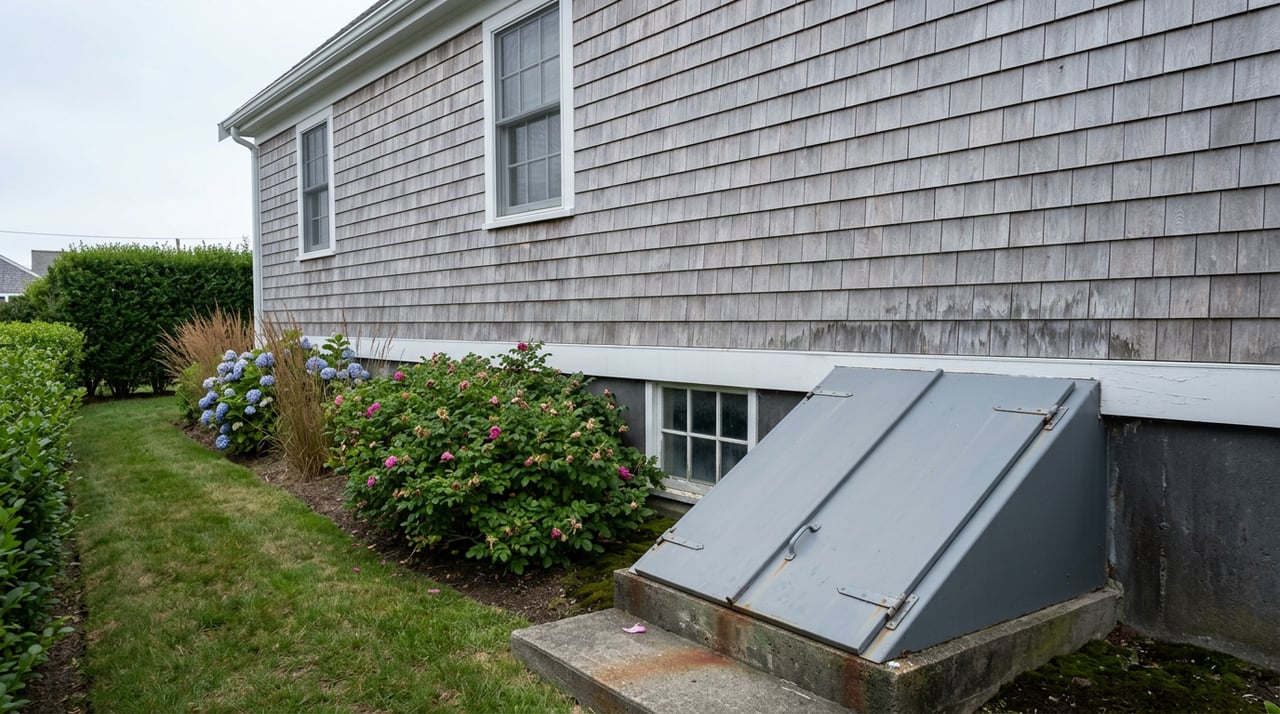
Marshfield Septic Inspections: What to Know Before a Home Sale
August 20, 2026
August 20, 2026
A Title 5 inspection is supposed to answer one question: is this septic system safe to keep using. According to AE Wood, in most Massachusetts towns, a passing report is a passing report, good for two years no matter who owns the house next. In Marshfield, that assumption trips up more sellers than almost any other closing detail, because the town's own Board of Health enforces rules stricter than the state code, and those rules land hardest on exactly the kind of house that fills Green Harbor, Brant Rock, and Rexhame: an older cottage that has quietly used the same cesspool since before anyone thought to write it down.
Massachusetts has required a septic inspection before a home sale since 1995, under the state environmental regulation known as Title 5. Under that state code, a cesspool does not automatically fail. It only needs to be upgraded if it shows signs of hydraulic failure, sits too close to a water supply, or otherwise threatens public health.
Marshfield layers its own rules on top of that state minimum. The town's Board of Health regulations, adopted under Massachusetts General Law Chapter 111, state plainly that where local rules are stricter than Title 5, the local rules govern. According to Title 5 Specialists, the town's published inspection criteria go further than the state's conditional language: a septic system built around a single cesspool is treated as something that needs to convert to a fully compliant system, not something that can pass simply because it isn't actively failing today.
That gap between "not currently failing" and "not compliant" is where sellers get surprised. A cesspool that would sail through a Title 5 review in a town that only enforces the state minimum can still get flagged in Marshfield, because the local board reads its own code as the higher bar.
The town's own regulatory record backs this up. A March 2025 amendment to Marshfield's sanitary sewage disposal rules, governing accessory dwelling units, sets specific tank and leaching-field sizing requirements tied directly to bedroom count, and reserves the town's right to require its own soil evaluation for seasonal high groundwater determination on top of whatever the state process already requires. That is a level of granular, house-by-house control most South Shore towns do not maintain.
This matters in Marshfield specifically because so much of the town's coastal housing predates the entire framework. Near the water, the mix runs from 1930s-era bungalows to farmhouses updated in the 1950s alongside newer waterfront builds. Further inland, near Green Harbor Golf Course, some homes date to the late 1700s. North Marshfield, one of the town's older, well-established sections, still shows large family homesteads on roads lined with original stone walls.
According to 413 Septic, Title 5 as a mandatory design standard for new construction only took effect in 1978. Anything built before that, and never formally upgraded since, is presumptively running on a cesspool rather than an engineered system with a tank, distribution box, and leach field. In a town where entire sections predate that line by decades, that history is worth checking before it becomes a surprise at inspection.
A standard Title 5 inspection in Massachusetts runs roughly $200 to $400, and routine pumping runs $150 to $250, based on typical Title 5 cost guidance published by Massachusetts municipal health departments. Those numbers are stable and manageable. The number that changes the conversation is what happens if the system needs full replacement: a complete septic system replacement can run as high as $40,000. That is the gap between a routine pre-listing task and a major line item nobody budgeted for.
Massachusetts does offer relief for exactly this situation. The Massachusetts guidance on Title 5 and septic systems says state law provides an income tax credit for the design and construction cost of repairing or replacing a failed cesspool or septic system, and the credit amount was increased for tax years starting in 2023. It is a real benefit, and sellers hear about it early in the process.
What often does not make it into that conversation is the eligibility requirement. The Massachusetts Department of Revenue's TIR 97-12 says the credit applies to an owner who occupies the property as a principal residence. A large share of the housing stock in Brant Rock, Green Harbor, and along Rexhame Beach is second-home or seasonal property, owned by people whose primary address is somewhere else. For that owner, the credit that friends and neighbors mention as a cushion simply does not apply. Anyone selling a seasonal cottage in one of these neighborhoods should treat the tax credit as a maybe, not a plan, until residency status is confirmed.
Once a Title 5 inspection identifies a system that needs to be upgraded, the standard timeline is two years from the date of that inspection. Two years sounds generous until the calendar gets filled in. Design, permitting, and scheduling a licensed installer routinely eats three to six months on its own, and installers on the South Shore book out further during the spring and summer construction season. Companies serving Marshfield directly, including All-Town Inc. out of Lone Street and firms like McGonagle Septic Service and Rosano Davis Sanitary Pumping, handle both routine pumping and full Title 5 work, and their schedules fill the same way every other local trade's does once the weather turns.
The Board of Health can grant extensions for documented financial hardship, but that is a conversation to start before the two-year window closes, not after. For anyone planning to sell an older Marshfield cottage in the next year or two, the practical move is to order the Title 5 inspection early and separately from the listing timeline. A passing report bought well ahead of a sale removes the single biggest variable from a transaction. A failing report discovered mid-contract turns a straightforward closing into a negotiation about who pays for what and when.
Here is the part that surprises people who assume septic rules are basically the same everywhere on the South Shore. They are not. Some neighboring towns built in more slack decades ago than Marshfield ever required. According to Buildx, Kingston has a history of mandating larger-than-minimum leaching fields on new systems, and Hanover used to require a 1,000-square-foot minimum leach field. Houses built under those older local standards often already have room to absorb an additional bedroom or an accessory unit.
Marshfield's local code took a different path, focused less on oversizing new systems and more on requiring full conversion away from cesspools. Two houses built the same year and the same size, one in Marshfield and one in a neighboring town, can carry genuinely different upgrade costs today, not because the soil is different, but because the Board of Health decades ago wrote different rules. Anyone comparing a Marshfield cottage to a similar listing in Kingston or Hanover is not just comparing square footage. They are comparing which set of decades-old local decisions they are inheriting along with the house.
Does a Title 5 report from a previous sale still count if I'm selling again soon after? Yes, generally, for two years from the inspection date, and it stays valid across multiple transfers within that window if the same inspection covers them. Confirm the exact date on the existing report before assuming it still applies.
Can I sell an older Brant Rock or Green Harbor cottage with a cesspool without upgrading it first? Not simply because an inspection finds no active failure; Marshfield’s local requirements call for a single-cesspool system to be converted to a fully compliant one.
What if the upgrade can't be finished before I want to close? The Board of Health can grant extensions for documented financial hardship on the standard two-year timeline.
Selling an older Marshfield home means knowing which code is actually being applied to it, not just the state minimum most guides describe. That is the kind of detail that belongs in a pre-listing conversation, not a post-inspection scramble. If you are weighing a sale in Green Harbor, Brant Rock, or anywhere else in town, The Guimares Group can walk through what your specific property's septic history means before you list, so the timeline stays yours to control.
This article is general information, not legal, tax or financial advice. Consult a qualified professional about your situation.
Stay up to date on the latest real estate trends.

October 22, 2026
October 15, 2026
October 8, 2026
October 1, 2026
August 27, 2026
August 20, 2026
August 13, 2026

August 6, 2026

August 6, 2026
For the best service and results when it comes to all of your real estate needs, reach out anytime.